
Our Purpose
Definitions of Prejudices and Stereotypes
Prejudice is an attitude; stereotype is a belief. A stereotype is a generalized idea about a group, while prejudice is a preconceived, usually negative, judgment or feeling toward that group.
What a stereotype is
A stereotype is a simplified, generalized belief about the characteristics or behaviors of a group.
- It is a cognitive shortcut — a belief or assumption.
- It can be positive or negative, but it is always an overgeneralization.
- It does not account for individual differences.
Example: “People from group X are naturally good at math.”
What prejudice is
Prejudice (literally “pre-judgment”) is an attitude or emotional bias, usually negative, toward a person or group.
- It is an unfounded opinion or feeling, not based on reason or experience.
- It often involves hostility, fear, or dislike.
- It can exist even without outward behavior.
Example: “I don’t like people from group X.”
Key difference in one line
- Stereotype = belief (“I think they are…”).
- Prejudice = attitude/feeling (“I feel negatively toward them…”).
How they interact
Stereotypes often feed into prejudice:
- A person first adopts a generalized belief (stereotype).
- That belief can then shape negative feelings (prejudice).
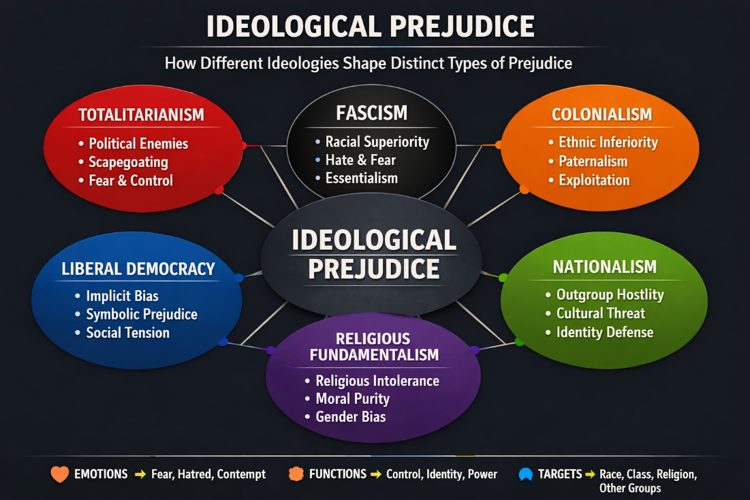


How Ideological Systems Produce Distinct Types of Prejudice
1. Totalitarianism (Soviet, Maoist, North Korean models)
Core mechanism: Ideological purity + enemy construction.
Dominant types of prejudice
- Political prejudice — hostility toward “class enemies,” “traitors,” “bourgeois elements,” “wreckers.”
- Value-expressive prejudice — the regime defines moral virtue; dissenters are morally corrupt.
- Scapegoating prejudice — failures are blamed on internal saboteurs.
- Conformity-based prejudice — citizens adopt official prejudices to avoid suspicion.
Emotional tone
- Fear-based (fear of deviation, fear of denunciation).
- Antipathy-based toward ideological outgroups.
Function
- Ego-defensive — citizens protect themselves by projecting blame onto “enemies.”
- Utilitarian — justifies repression, purges, and forced labor.
Historical examples
- Stalinist campaigns against “kulaks,” “cosmopolitans,” “rootless intellectuals.”
- Maoist persecution of “rightists” and “counterrevolutionaries.”
2. Fascism (Nazi Germany, Italian Fascism, etc.)
Core mechanism: Biological essentialism + mythic nationalism.
Dominant types of prejudice
- Racial prejudice — central and biologically codified.
- Essentialist prejudice — groups are defined as inherently inferior or dangerous.
- Envy-based prejudice — resentment toward groups portrayed as powerful or conspiratorial.
- Paternalistic prejudice — toward “weaker” groups needing control.
Emotional tone
- Hatred + fear — the combination that enables mass violence.
Function
- Value-expressive — purity, strength, hierarchy.
- Utilitarian — economic exploitation, territorial expansion.
Historical examples
- Antisemitism, anti-Roma policies, eugenics, “degenerate art” campaigns.
3. Colonialism and Imperialism
Core mechanism: Civilizational hierarchy + economic extraction.
Dominant types of prejudice
- Ethnic prejudice — colonized peoples portrayed as inferior.
- Paternalistic prejudice — “civilizing mission,” infantilization.
- Utilitarian prejudice — justifies forced labor, resource extraction.
- Stereotype-based prejudice — fixed images of “natives.”
Emotional tone
- Paternalism + contempt — a unique combination.
Function
- Knowledge-based — simplifies complex societies into stereotypes.
- Utilitarian — legitimizes domination.
Historical examples
- British rule in India, French rule in Algeria, Belgian Congo.
4. Nationalism (ethnic, civic, and exclusionary forms)
Core mechanism: Ingroup identity + boundary-making.
Dominant types of prejudice
- Outgroup derogation — toward minorities or neighboring nations.
- Symbolic prejudice — coded language about “culture,” “values,” “traditions.”
- Fear-based prejudice — threat narratives about outsiders.
Emotional tone
- Fear + resentment — especially during crises.
Function
- Value-expressive — protecting the “nation’s soul.”
- Ego-defensive — national humiliation projected onto outgroups.
Historical examples
- Balkan nationalisms, interwar Eastern Europe, contemporary far-right movements.
5. Liberal Democracies (modern Western systems)
Core mechanism: Equality norms + implicit bias.
Dominant types of prejudice
- Implicit prejudice — unconscious biases in institutions.
- Aversive prejudice — professed egalitarianism + subtle avoidance.
- Symbolic prejudice — expressed through cultural or economic arguments.
- Political prejudice — affective polarization between ideological camps.
Emotional tone
- Ambivalence — conflict between norms and biases.
Function
- Knowledge-based — cognitive shortcuts in diverse societies.
- Value-expressive — moralized political identities.
Historical examples
- Housing discrimination, policing disparities, partisan hostility.
6. Religious Fundamentalism (various traditions)
Core mechanism: Sacred values + moral absolutism.
Dominant types of prejudice
- Religious prejudice — toward heretics, apostates, or other faiths.
- Gender prejudice — codified in doctrine.
- Value-expressive prejudice — moral purity vs. corruption.
Emotional tone
- Moral disgust — a powerful driver of exclusion.
Function
- Ego-defensive — protects identity against modernity.
- Value-expressive — reinforces sacred norms.
Historical examples
- Witch hunts, sectarian conflicts, moral policing.
Synthesis Table: Ideology → Prejudice Type
| Ideology | Dominant Prejudice Types | Emotional Tone | Function |
| Totalitarianism | Political, scapegoating, conformity-based | Fear | Control + purification |
| Fascism | Racial, essentialist, envy-based | Hatred + fear | Expansion + hierarchy |
| Colonialism | Ethnic, paternalistic, utilitarian | Contempt + paternalism | Extraction + domination |
| Nationalism | Outgroup derogation, symbolic | Fear + resentment | Identity protection |
| Liberal Democracy | Implicit, aversive, symbolic | Ambivalence | Cognitive simplification |
| Religious Fundamentalism | Religious, gender, value-expressive | Moral disgust | Norm enforcement |
Why this matters for your work
This mapping gives you a comparative psychological grammar of ideological systems. It shows that:
- Prejudice is not random — each ideology cultivates specific emotional and cognitive patterns.
- Prejudice is functional — it stabilizes power, identity, and hierarchy.
- Prejudice varies by regime type — from explicit (fascism) to implicit (liberal democracies).
Description of Russian Prejudices and Psychological Traumas in my books: