
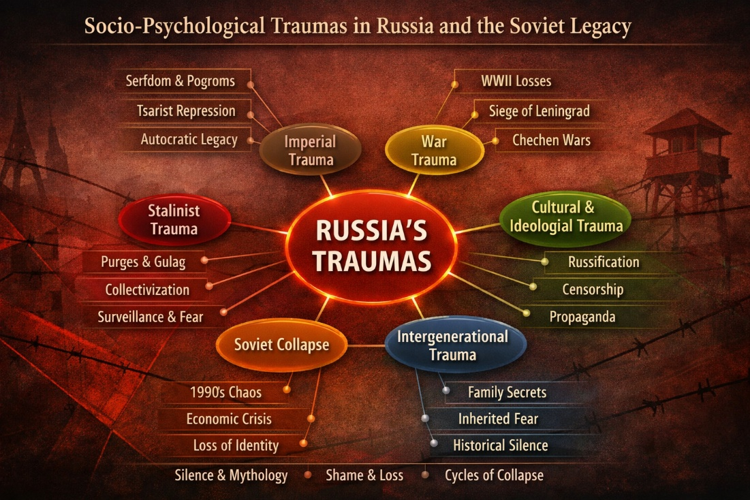
Introducing Socio Psychological Traumas
Socio psychological trauma is damage to the psyche caused not only by individual events but also by social systems, historical factors, collective experiences, and the ideological environment. It is trauma that is shared, transmitted, normalized, or institutionalized.
Social and psychological trauma occurs as a result of events or prolonged environmental influences that exceed the ability of an individual or community to cope, leaving indelible marks on the mind, body, and social connections.
The Architecture of Suffering: Socio‑Psychological Trauma in Russia and the Soviet Legacy
Trauma in Russia is not a single wound but a stratified emotional geology — layers of fear, humiliation, and silence accumulated over centuries of autocracy, revolution, war, and ideological absolutism. It is a collective condition that transcends individual psychology, shaping national identity and moral perception. To understand Russia’s socio‑psychological trauma is to trace how historical violence becomes emotional inheritance, how systems of power sculpt the inner life of generations.
1. The Historical Genesis of Russian Trauma
The roots of Russian trauma reach deep into the imperial and pre‑revolutionary past, where serfdom and autocracy created a culture of submission and fatalism. For centuries, peasants lived under conditions of near‑total dependency, deprived of agency and dignity. The abolition of serfdom in 1861 did not erase the psychological imprint of servitude; it merely transferred it into new forms of bureaucratic control and social hierarchy. The Tsarist system cultivated obedience as virtue and dissent as sin — a moral inversion that would later be perfected under Soviet rule.
This imperial trauma established the emotional template for later epochs: fear of authority, distrust of neighbors, and the internalization of hierarchy. Pogroms and ethnic violence added another layer — the trauma of scapegoating and collective guilt. By the early twentieth century, Russia was a society primed for revolutionary rupture, yet psychologically unprepared for freedom.
2. The Revolutionary Trauma: Collapse of the Moral World
The Bolshevik Revolution of 1917 was not only a political upheaval but a moral cataclysm. It destroyed the old world without replacing it with a stable new one. The civil war that followed unleashed unprecedented brutality: executions, famine, and displacement on a scale that shattered social bonds. Ideology replaced religion as the source of meaning, but it demanded faith without mercy. The revolution’s promise of liberation quickly turned into a system of moral absolutism — virtue defined by class hatred, compassion redefined as weakness.
This period produced what psychologists call identity trauma: the collapse of moral coherence. Individuals were forced to choose between survival and conscience, between loyalty to ideology and loyalty to human relationships. The emotional tone was confusion and disorientation — a society learning to live without moral gravity.
3. Stalinism: The Institutionalization of Fear
Under Stalin, trauma became systemic and bureaucratic. The state transformed fear into a governing technology. Millions were arrested, executed, or sent to the Gulag; millions more lived in constant dread of denunciation. The family, traditionally a refuge, became a site of danger — children were encouraged to inform on parents, neighbors on neighbors. The result was a profound attachment trauma: the destruction of trust as a psychological foundation.
The Stalinist period also produced moral trauma. Citizens were compelled to participate in injustice — signing false confessions, denouncing colleagues, applauding show trials. The moral inversion of the revolution reached its peak: cruelty became patriotic, silence became survival. The psyche adapted through emotional numbing and conformity. Fear was not an episodic emotion but a permanent state of being.
Intergenerationally, this trauma was transmitted through silence. Families concealed their histories to protect themselves and their children. The unspoken became sacred; forgetting became a moral duty. This silence, paradoxically, preserved trauma rather than healing it. It created a culture where suffering was known but never articulated — a collective unconscious saturated with fear.
4. The Great Patriotic War: Heroism and Devastation
World War II added another layer of trauma, both heroic and catastrophic. The Soviet Union lost over twenty‑seven million people. Cities were destroyed, families annihilated, and entire generations marked by grief. Yet the regime transformed this suffering into a myth of victory. The trauma of loss was sublimated into pride; mourning was replaced by glorification.
This duality — trauma fused with triumph — remains central to Russian psychology. The war became a sacred narrative that justified future suffering. The emotional signature is survivor guilt mixed with moral exaltation. The inability to mourn openly perpetuated emotional repression. The glorification of endurance became a national virtue, reinforcing the idea that suffering is redemptive.
5. Late Soviet Period: Cynicism and Emotional Exhaustion
By the 1960s and 1970s, overt terror had subsided, but the psychological residue remained. The late Soviet era was marked by chronic trauma — a slow erosion of meaning. Citizens lived in a world of doublethink: public conformity and private skepticism. Ideology persisted as ritual, not belief. The emotional tone shifted from fear to cynicism and fatigue.
This period produced existential trauma — the sense of living in a system that no longer believed in itself. Alcoholism, apathy, and quiet despair became coping mechanisms. The state’s repression was now psychological rather than physical: the suppression of initiative, creativity, and individuality. The trauma of stagnation was subtle but pervasive — the wound of emptiness.
6. The Post‑Soviet Collapse: Humiliation and Identity Loss
The dissolution of the USSR in 1991 was experienced not as liberation but as collective humiliation. Overnight, a superpower became a fragmented state. Economic collapse, crime, and poverty replaced ideological control. The trauma of the 1990s was shame‑based: the shame of failure, of poverty, of lost status. For many, the chaos of freedom felt more traumatic than the stability of repression.
This period reactivated older patterns of fatalism and nostalgia. The longing for order and authority resurfaced as a psychological defense against uncertainty. The emotional signature was resentment — a mixture of wounded pride and moral confusion. The post‑Soviet generation inherited not only the material ruins of the empire but the emotional ruins of its ideology.
7. Contemporary Russia: The Return of Fear and Moral Polarization
In the twenty‑first century, Russia has entered a new cycle of trauma. The state’s consolidation of power, wars, and propaganda have revived the emotional mechanisms of the Soviet past. Fear has returned, now blended with moral fatigue and defensive nationalism. The trauma of the present is not only political but existential: the sense of being trapped in history’s repetition.
The psychological pattern is trauma without catharsis. Each epoch represses the previous one rather than integrating it. The result is a collective psyche oscillating between pride and shame, aggression and despair. The glorification of suffering continues to serve as moral justification for endurance. The inability to process pain perpetuates the cycle.
8. Mechanisms of Transmission: Silence, Myth, and Behavior
Russian trauma is transmitted through three primary mechanisms:
Silence
Families conceal their histories; society avoids confrontation with its past. Silence becomes both shield and prison. It prevents healing by denying articulation. The unspoken becomes inherited anxiety.
Mythologization
Trauma is transformed into heroic narrative. The Gulag becomes “necessary sacrifice,” war becomes “holy victory,” repression becomes “discipline.” Myth replaces memory, turning suffering into virtue.
Behavioral Transmission
Trauma manifests in emotional patterns: hypervigilance, distrust, avoidance of politics, and moral ambivalence. These behaviors are learned responses to historical danger, passed down unconsciously.
Together, these mechanisms create a culture of emotional containment — a society that remembers through avoidance.
9. The Emotional Grammar of Russian Trauma
Across these epochs, certain emotional constants define the Russian experience:
| Emotional Core | Historical Expression | Psychological Outcome |
| Fear | Stalinist terror, surveillance | Hypervigilance, conformity |
| Shame | Post‑Soviet collapse | Humiliation, resentment |
| Silence | Intergenerational secrecy | Emotional inhibition |
| Moral confusion | Ideological inversion | Cognitive dissonance |
| Fatalism | Imperial and Soviet continuity | Passivity, dependence |
| Nostalgia | Post‑Soviet longing | Idealization of authority |
These emotions form a collective emotional grammar — the syntax through which Russian society interprets suffering and power.
10. The Intergenerational Dimension
The most enduring aspect of Russian trauma is its intergenerational transmission. Children of Gulag survivors inherit fear without knowing its source. Families carry unspoken histories that shape emotional development. Psychologists describe this as transgenerational haunting — the persistence of unprocessed grief across generations.
In Russia, this haunting is amplified by the state’s refusal to acknowledge its crimes. Without public recognition, private healing becomes impossible. The result is a society where trauma is normalized, even valorized. The emotional inheritance is paradoxical: pride in endurance, shame in vulnerability.
11. The Cultural Consequences
Socio‑psychological trauma has shaped Russian culture in profound ways:
- Literature reflects moral struggle and existential despair (Dostoevsky’s guilt, Solzhenitsyn’s witness, Grossman’s compassion).
- Art and film oscillate between realism and myth, between exposure and concealment.
- Religion and ideology merge into moral absolutism — suffering as purification.
- Political behavior reflects learned helplessness and longing for paternal authority.
The trauma of history becomes the aesthetic of endurance.
What causes trauma?
Trauma is an emotional, psychological, or physical reaction to a life-threatening or deeply emotionally distressing event. It occurs when a person lacks the resources or support needed to cope. While the event itself is the catalyst, trauma is ultimately determined by how the experience affects a person’s nervous system and sense of safety.
Traumatic events are generally categorized into three types: acute (a single event), chronic (long-term impact), and complex (multiple different events).
- Single or Sudden Events (Acute Trauma)
These include unexpected, horrific, and isolated incidents:
- Severe accidents: motor vehicle accidents or severe injuries.
- Medical events: sudden life-threatening diagnoses, traumatic births, or awakenings during surgery.
- Natural disasters: earthquakes, floods, hurricanes, or fires.
- Loss: The sudden or violent loss of a loved one.
- Assault: Violent crimes, physical attacks, or robberies.
- Prolonged or Recurring Stressors (Chronic Trauma)
This includes ongoing, repeated exposure to an extremely stressful, dangerous, or unsupportive environment:
- Abuse: Childhood emotional, physical, or sexual abuse, as well as intimate partner violence.
- Bullying and Harassment: Long-term bullying in the workplace or at school.
- Conflict: Living in a war zone or experiencing severe political repression and torture.
- Neglect: Growing up in an unstable environment without emotional support or basic needs met.
- Often Overlooked Causes
Trauma is largely subjective. What one person finds traumatic, another may not. Other common triggers include:
- The end of a significant relationship.
- Humiliation or severe rejection.
- Secondary trauma: the development of trauma symptoms due to repeated exposure to traumatic details in the lives of others, which is very common among emergency responders, healthcare workers, and therapists.
- Systemic trauma: persistent stress caused by discrimination, racism, or systemic marginalization.